Category: dental implants

  • Mini Dental Implants: Benefits, Cost, Eligibility, Procedure, Recovery

    You’re missing a tooth. Or your dentures keep shifting when you eat or speak. You’ve looked into dental implants but heard you might not have enough bone. So you’ve been putting it off.

    This is exactly what many patients in Kochi, Kannur and Calicut come in with. And for a good number of them, mini dental implants turn out to be the option that works.

    Mini implants are smaller, less invasive and need less bone than traditional implants. If you’ve been searching for teeth implants near me or trying to understand your options before visiting a clinic, this guide covers mini dental implants – benefits, cost, eligibility, procedure.

    At Elite Dental Studio, our implantology team at the dental implant clinic Kochi, Calicut and Kannur checks your bone support, gum health and jaw structure before recommending anything.

    WHAT ARE MINI DENTAL IMPLANTS AND HOW ARE THEY DIFFERENT?

    A mini dental implant is a small titanium post, less than 3 millimetres wide, placed into the jawbone to support a replacement tooth or hold a denture in place. Traditional dental implants use a two-piece post ranging from 3.25 to 5 millimetres wide.

    That size difference changes the entire experience for the patient. Mini implants are one solid piece. They need less bone, cause less disruption to surrounding tissue and often don’t need stitches after placement.

    They work well for single missing teeth, dental bridges and stabilising loose lower dentures. They’re not the right choice for every case, but for the right patient, they get the job done with less procedure and faster healing.

    WHAT ARE THE BENEFITS OF MINI DENTAL IMPLANTS?

    Mini dental implants are worth considering when you want a fixed tooth replacement without a lengthy surgical process. Here’s what patients notice most.

    • LESS INVASIVE. The smaller post means less drilling and less disruption to the tissue around it. Many cases need no stitches at all.
    • FASTER RECOVERY. Most patients return to normal activity within one to two days. Traditional implants take seven to fourteen days.
    • NO BONE GRAFTING IN MOST CASES. Because mini implants need less bone, patients who can’t get traditional implants often don’t need bone grafting either.
    • SAME-DAY PLACEMENT IN SUITABLE CASES. The implant and replacement tooth can often be fitted in one visit.
    • MORE AFFORDABLE. Mini implants cost less than traditional implants in most cases, making tooth replacement more accessible.

    YOU WERE TOLD YOU DON’T HAVE ENOUGH BONE. DOES THAT RULE OUT MINI IMPLANTS TOO?

    Not always. This is the most common concern patients bring in when they first visit a dental implant clinic in Kochi or the best dental implant clinic in Kannur. And it’s also the most common reason people delay treatment unnecessarily.

    Traditional implants need a specific amount of jawbone density to anchor securely. When that bone isn’t there, patients are usually told they need bone grafting first. That adds another procedure, more healing time and more cost. Many patients simply stop at that point and do nothing.

    Mini implants are narrower. They sit in less bone. Many patients who were turned away for traditional implants are good candidates for mini implants without any grafting at all.

    That said, some cases genuinely aren’t suitable. Severe bone loss or active gum infection may rule out mini implants too. The only way to know is a proper clinical check with X-rays. Patients who come in after searching for teeth implants near me are often surprised to find they qualify for an option they hadn’t heard about.

    WHO IS ELIGIBLE FOR MINI DENTAL IMPLANTS?

    Eligibility depends on what the dentist finds during the check. Here’s a general picture.

    GOOD CANDIDATES

    • Adults with one or more missing teeth who want a fixed or semi-fixed solution
    • Patients with loose or shifting dentures, especially lower jaw dentures
    • Patients with lower bone density who don’t qualify for traditional implants
    • Patients who want a less invasive procedure and faster recovery
    • Patients replacing small teeth or fitting into narrow jaw spaces

    CASES WHERE MINI IMPLANTS MAY NOT BE SUITABLE

    • Children and teenagers whose jaw is still growing
    • Patients who grind their teeth severely
    • Patients with uncontrolled diabetes or conditions that affect healing
    • Cases involving back molars where chewing pressure is highest
    • Patients with very severe bone loss or active gum disease

    Suitability is confirmed only after a clinical check, X-ray and review of your dental and medical history.

    WHAT DOES THE MINI DENTAL IMPLANT PROCEDURE ACTUALLY INVOLVE?

    Most patients are surprised by how straightforward this is.

    1. CONSULTATION AND IMAGING. The dentist checks bone density, gum health and jaw structure. X-rays or a 3D scan map exactly where the implant will be placed.
    2. TREATMENT PLANNING. Implant position, number of implants and the type of prosthetic are decided based on what the scan shows and what the patient needs.
    3. LOCAL ANAESTHESIA. The area is numbed before the procedure. Most patients feel pressure but not pain during placement.
    4. IMPLANT PLACEMENT. The titanium post goes into the jawbone. In many cases, no incisions or stitches are needed. The full procedure usually takes under an hour.
    5. PROSTHETIC FITTING. The crown, bridge or denture is attached to the implant. In suitable cases, this happens on the same day.
    6. AFTERCARE GUIDANCE. You leave with clear instructions on diet, cleaning and what to watch for during healing.

    At Elite Dental Studio, our implantology and prosthodontics team reviews bone support, gum condition and bite before planning any dental implant treatment. We don’t recommend a procedure before confirming it suits your case. The clinic was named Famdent Clinic of the Year 2026 across all three branches and has treated over 1,00,000 patients in Calicut, Kochi and Kannur since 2020. Free consultations are available at all locations.

    HOW LONG IS RECOVERY AFTER MINI DENTAL IMPLANTS?

    Recovery is one of the clearest differences between mini and traditional implants.

    • Most patients are back to normal within one to two days
    • Mild soreness settles with standard over-the-counter pain relief
    • Gum tissue heals within two to five days
    • Full bone integration, where the bone fuses around the post, takes around three months

    Eat soft foods for the first few days. Avoid hard and sticky foods. Don’t smoke during healing. Brush gently around the implant site and use any rinse your dentist recommends. Contact your dentist if you notice unexpected swelling, severe pain or bleeding beyond the first day.

    WHAT DOES MINI DENTAL IMPLANT TREATMENT COST IN KERALA?

    Cost depends on the case. There’s no single figure that applies to everyone.

    FACTORS THAT AFFECT THE COST:

    • Number of implants needed
    • Type of prosthetic being attached: crown, bridge or denture
    • Whether imaging like X-rays or a 3D scan is needed
    • Complexity of the case and number of visits required
    • Any preparatory treatment needed before placement

    Mini implants cost less than traditional implants in most cases. The exact figure for your situation can only be confirmed after a clinical check. Our dental implant clinic in Kochi at Panampilly Nagar and the best dental implant clinic in Kannur at Talap both offer free consultations where the team checks your case and gives you a clear treatment plan before any decision is made.
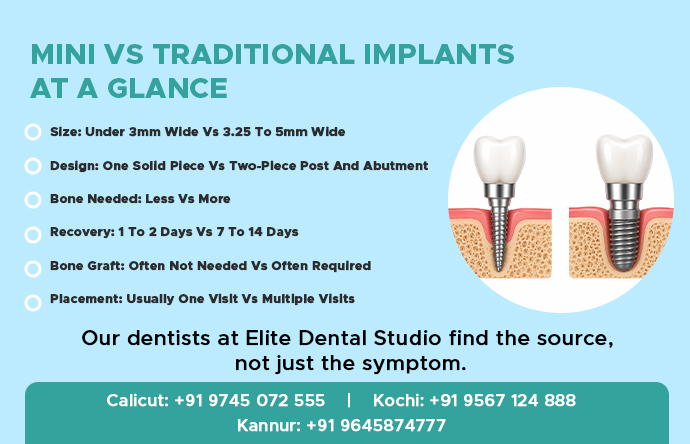
    mini Vs traditional implants at a glance

    IF YOU’RE CONSIDERING MINI DENTAL IMPLANTS, START WITH A CHECK

    Many patients who come in for a mini dental implant consultation have been living with a missing tooth or an unstable denture for months or years. They assumed implants weren’t an option for them. In a lot of cases, they were wrong.

    Our implantology team at Elite Dental Studio checks your bone support, gum condition and jaw structure specifically for mini implant suitability before suggesting any treatment. If mini implants are right for you, we plan the procedure around your case. If they’re not, we tell you that too and explain what the alternatives are.

    Elite Dental Studio was named Famdent Clinic of the Year 2026 across all three branches and has treated over 1,00,000 patients in Calicut, Kochi and Kannur since 2020. Free mini dental implant consultations are available at our dental implant clinic in Kochi at Panampilly Nagar, the best dental implant clinic in Kannur at Talap and our Calicut branch at Eranhipalam.

    FREQUENTLY ASKED QUESTIONS

    ARE MINI DENTAL IMPLANTS AS STRONG AS TRADITIONAL IMPLANTS?
    They’re strong enough for most cases including single teeth, bridges and denture stabilisation. They’re not ideal for back molars where chewing pressure is highest. Your dentist will confirm which suits your bite and bone after a check. Our team covers this during the mini dental implants consultation on benefits, cost, eligibility and procedure.

    CAN MINI DENTAL IMPLANTS HOLD DENTURES IN PLACE?
    Yes. Stabilising loose lower dentures is one of the most common uses for mini implants. They act as anchors that stop the denture from shifting while eating or speaking. Most patients notice a clear difference immediately after fitting.

    HOW DO I FIND TEETH IMPLANTS NEAR ME IN KOCHI OR KANNUR?
    Elite Dental Studio has clinics in Kochi at Panampilly Nagar and in Kannur at Talap. If you’ve been searching for teeth implants near me, book a free consultation and our team checks your eligibility and explains your options based on your actual case.

    HOW LONG DO MINI DENTAL IMPLANTS LAST?
    With proper care and regular dental check-ups, mini implants can last many years. Longevity depends on oral hygiene, diet, habits like grinding and follow-up visits. Your dentist will guide you on maintenance after the procedure.

    DOES THE BEST DENTAL IMPLANT CLINIC IN KANNUR OFFER FREE CONSULTATIONS FOR MINI IMPLANTS?
    Yes. Elite Dental Studio Kannur at Talap, opposite Koyili Hospital, offers free consultations for mini dental implant planning. The team checks bone support, gum health and suitability before recommending anything. Patients from Pallikkunnu, South Bazar, Thalikkavu and wider Kannur visit regularly for implant checks.

  • How To Keep Dental Implant Clean And Hygienic?

    Dental implants are built to last, but most patients worry about hygiene. They ask, “How do I clean it properly?” or “Will food get stuck?” or “Can the gums get infected?” If you searched teeth implants near me, you likely want an implant that stays comfortable, clean, and problem-free for years.

    Here is the direct answer. You keep a dental implant clean and hygienic by brushing twice daily, cleaning between teeth every day, rinsing correctly when advised, and attending regular professional implant cleanings. This routine protects the gums and bone around the implant.

    At Elite Dental Studio, Calicut, we follow a structured implant hygiene protocol that covers home care, professional implant-cleaning, and a recall-schedule to protect gum-health and long-term implant-survival. This guide explains what to do daily, what tools help most, what habits to avoid, and when to book a maintenance visit at the best dental implant clinic in Calicut.

    daily-implant-hygiene-checklist

    What Should You Know About Implant Hygiene Before You Start Cleaning?

    Dental Implants: What You Should Know is simple. An implant cannot get cavities, but the gums and bone around it can get inflamed or infected if plaque stays near the gum-line. That is why implant hygiene focuses on two things: clean implant-surfaces and healthy gums.

    A clean-looking crown is not enough. Real hygiene means consistent plaque-removal and biofilm-control around the implant and the surrounding teeth.

    How Dentists Plan An Implant Hygiene Routine For You?

    At Elite Dental Studio, your implant hygiene plan is tailored based on how easy it is for you to clean around the implant. We check the gum-line health, implant position, and whether you have tight-contacts that trap food-debris.

    We also assess plaque-accumulation risk and recommend tools that match your access, such as an interdental-brush, proxy-brush, or water-flosser for stronger biofilm-control. This step-by-step planning keeps the routine realistic, so patient-responsibility stays consistent long term.

    What Daily Routine Keeps A Dental Implant Clean And Hygienic?

    Daily care keeps implant-surfaces clean and prevents plaque buildup at the gum-line. A strong routine has two anchors: morning-routine and night-brushing. Most hygiene problems happen when patients clean only the crown and skip the areas around the gum-line.

    Morning routine

    • Use a soft-bristle brush and keep pressure-control steady.
    • Brush with gentle-circles and no-scrubbing along the gum-line.
    • Focus on crown-cleaning and the edges where the crown meets the gum.
    • Use fluoride-toothpaste that is low-abrasive.
    • Add a post-meal-rinse later in the day when brushing is not possible.

    Night routine

    Night is where results are protected.

    • Do twice-daily brushing, and make night-brushing the more detailed one.
    • Clean between teeth and around the implant with once-daily interdental cleaning.
    • If you have tight-contact, take extra time to reach each space with the right tool.

    This is the same habit set we teach patients who come to us after searching for teeth implants near me and want long-term implant safety.

    Which Toothbrush And Toothpaste Are Best For Dental Implants?

    A brush that cleans well without irritating the gums is the goal. A soft-bristle brush works for most patients. An electric-toothbrush can help if your brushing is inconsistent or if you struggle to reach back teeth.

    Choose a low-abrasive toothpaste. It keeps cleaning effective without harsh rubbing. Fluoride-toothpaste is a safe daily option for overall oral health, especially for natural teeth around implants.

    For precision cleaning, your dentist may recommend:

    • single-tuft-brush for corners and hard-to-reach areas.
    • tapered-brush for better access behind the implant crown.
    • rubber-tip-stimulator to massage the gum margin gently, if advised.

    Always maintain pressure-control. Avoid no-scrubbing habits that can injure gums. Gentle, consistent plaque-removal is the priority.

    How Should You Floss And Clean Between Teeth With An Implant?

    Interdental cleaning removes hidden food-debris and supports gum-health around implants. Daily-flossing is one of the biggest differences between implants that stay healthy and implants that develop gum problems. This is especially important for people who searched teeth implants near me and want long-term confidence in their implant.

    Best Flossing And Interdental Tools

    • Floss-threader to guide floss around implant areas.
    • Super-floss for better grip and control.
    • Bridge-threader when access is tight under bridges.
    • Interdental-brush or proxy-brush for wider spaces.
    • Proxybrush for quick cleaning when recommended.
    • Floss-pick-alternative only if it reaches the correct zone without snapping on gums.

    Water-Based Tools

    • Water-flosser or oral-irrigator to flush food-debris.
    • Waterpik is a common option for home use.
    • Cordless-flosser for convenience.
    • Portable-irrigator or travel-flosser when you travel.
    • Home-irrigation can support biofilm-control when used consistently.

    How To Clean The Key Areas

    • Focus on abutment-cleaning where the crown meets the gums.
    • Clean sub-gingival areas gently only if instructed.
    • Use angle-access behind the implant crown where plaque builds faster.
    • Do night-floss so the area stays cleaner overnight.
    • Keep the goal once-daily interdental cleaning, even on busy days.

    Should You Use Mouthwash After Dental Implants?

    Rinses support bacteria control when used correctly and only for the right duration. Mouthwash is not a substitute for brushing or flossing, but it can support gum-health in specific situations.

    What Works And What To Avoid! 

    • Antimicrobial-rinse can be useful when recommended.
    • Chlorhexidine or CHX-gluconate may be prescribed for short-term use.
    • Saltwater-rinse can support comfort and cleanliness.
    • Choose no-alcohol options to avoid dryness and irritation.
    • Use post-meal-rinse when brushing is not possible.

    Do not self-use diluted-bleach or strong mixtures. Use a therapeutic-rinse only when your dentist advises it.

    What Food And Habits Keep Implants Hygienic And Safe?

    Food choices matter because trapped debris and hard bites can irritate tissues and increase plaque-accumulation.

    Diet tips

    • Follow a soft-diet if tenderness is present.
    • Choose no-hard-foods during sensitive periods.
    • Avoid-ice to prevent sudden stress.
    • No-nutshells to avoid cracking restorations.
    • Crunchy-avoid if food repeatedly sticks.
    • Limit sticky-foods that cling near the gum margin.
    • Maintain hydration.
    • Follow sugar-control to support gum stability.

    Habits that protect implant hygiene

    • no-smoking is one of the strongest protectors of implant-survival.
    • Stay tobacco-free to reduce mucositis and peri-implantitis risk.

    What Professional Care Keeps Implants Healthy Long Term?

    Professional checks catch early inflammation and protect the bone around the implant. Even if home care is excellent, professional maintenance ensures long-term stability and reduces the risk of hygiene-failure.

    What Happens During Professional Visits

    • 6-month-check to assess gum status and implant health.
    • Prophy and implant-cleaning using specialized-tools.
    • Air-polishing where appropriate.
    • Debridement and scaling when plaque or tartar-buildup is present.
    • X-ray-review when needed to monitor bone levels.
    • Maintenance-visit planning and perio-monitoring.

    These visits help with early-detection and reduce the chance of bone-loss over time.

    What Are The Warning Signs That Your Implant Needs A Dentist Visit?

    Early signs around implants should be treated early to prevent peri-implantitis and bone-loss. Book a visit if you notice:

    • bleeding-gums around the implant.
    • pus-discharge or bad taste.
    • infection-signs such as swelling or ongoing tenderness.
    • mucositis that does not settle.
    • plaque-accumulation and tartar-buildup that returns quickly.
    • loose-implant feeling or mobility-warning.
    • discomfort while chewing.

    Overload-prevent planning is also important. If your bite feels off, get it checked early.

    How Long Can Implants Last If Hygiene Is Consistent?

    With consistent-habits and a stable hygiene-routine, many implants function well for 10-15-years and beyond. Many cases report outcomes close to 95-percent-success with proper maintenance.

    Long-term success depends on compliance-key habits and a dentist-partnership. The best results come from lifetime-care, a clear recall-schedule, and patient-responsibility for daily cleaning.

    Why Choose Elite Dental Studio For Implant Hygiene Support In Calicut?

    If you are searching for teeth implants near me, you are not only looking for placement. You want a clinic that supports hygiene, follow-up, and long-term implant stability.

    At Elite Dental Studio, we create practical implant care routines based on your gum-line health, implant position, and cleaning access. Our team focuses on prevention, early-detection, and longevity-tips so your implant stays stable and comfortable. For patients looking for the best dental implant clinic in calicut, our approach includes professional implant-cleaning, structured maintenance visits, and guidance that makes Dental Implants: What You Should Know easy to apply in daily life.

    Book Your Appointment at Elite Dental Studio, Calicut! 

    Elite Dental Studio, Calicut offers implant maintenance visits, professional cleaning, and hygiene guidance for long-term implant safety.

    If you have an implant already, or you are planning one and want a clean long-term routine, book an implant hygiene check at Elite Dental Studio, Calicut.

    Call +91 97450-72555 to schedule your visit.

    FAQs

    How do I keep my dental implant clean daily?
    Brush twice-daily and clean between teeth once daily, focusing on the gum-line around the implant.

    Is flossing necessary for implants?
    Yes. daily-flossing removes food-debris and plaque from areas a toothbrush cannot reach.

    Can implants get infected even if the crown looks clean?
    Yes. plaque-accumulation at the gum-line can cause mucositis and progress to peri-implantitis if ignored.

    What mouthwash should I use after implants?
    Use rinses only as advised. Some patients may need chlorhexidine or CHX-gluconate for short-term support.

    How often should implants be professionally cleaned?
    Most patients benefit from a 6-month-check and regular maintenance-visit planning based on perio-monitoring.

  • All About Implant Healing Stages

    Dental implants are a long-term solution, but most patients worry about the healing time. They want to know what is normal after surgery, how healing progresses week by week, and when the final tooth will be placed. If you searched dental implant healing stages, you are likely planning treatment or you already had implant surgery.

    Dental implant healing usually takes 3 to 6 months. During this time, the implant bonds with the jawbone, the gums heal, and the foundation becomes strong enough to support a permanent crown.

    Implant healing follows a clear timeline. Your bone and gums repair step by step until the implant becomes stable and functional. At Elite Dental Studio, we guide patients who search for teeth implants near me and dental implants near me through every stage with planned follow-ups. This guide explains the healing stages, what you may feel at each phase, and how to protect your results.

    what-are-implant-healing-stages

    What Are Implant Healing Stages?

    Dental Implant healing stages are the natural healing-stages your body follows after implant surgery. The goal is osseointegration, where the implant bonds with bone through bone-integration and titanium-fusion. Healing happens in phases, and each phase builds on the previous one.

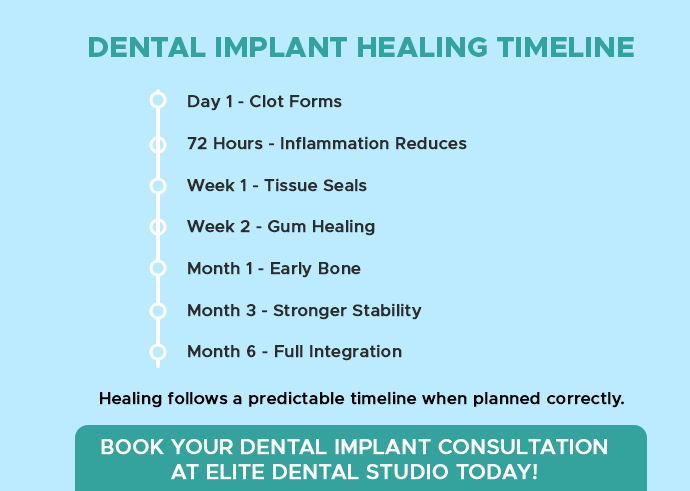
    Implant Healing Timeline At A Glance

    Time What Happens What You Should Do
    Day-1 Blood clot forms, inflammation phase begins Rest, ice compress, soft food
    72 Hours Swelling reduces, early repair starts Follow hygiene protocol, avoid smoking
    Week-1 Incision site seals, sutures may stay Gentle cleaning, follow-up
    Week-2 Gingival healing improves, tissue closure Saltwater rinse, chlorhexidine if advised
    Month-1 Early bone repair starts Chew carefully, keep area clean
    Month-3 Stronger bone forms, stability increases Attend recall visits, follow loading plan
    Month-6 Full integration and maturation Permanent crown planning, long-term care

    This dental implant timeline helps patients looking for the best dental implant clinic in Kannur understand what to expect.

    What Happens On Surgery Day?

    On surgery-day, the implant is placed under a sterile-field. The dentist creates an incision-site and places the implant. A cover-screw or healing-collar may be used. The gums are closed with flap-closure using a tension-free approach. This reduces surgical-trauma.

    The implant’s first strength is called primary-stability. It comes from how firmly the implant sits in the bone at placement.

    What Happens In The First 72 Hours After Dental Implant?

    The first 72-hours is the immediate-healing window. A blood-clot forms around the implant. This supports clot-stabilization. Mild swelling or hematoma can occur.

    What helps most in this stage:

    • ice-compress during the first day, as advised.
    • soft-food and plenty of fluids.
    • no-smoking, as smoking increases failure-risk.
    • follow post-op-care instructions carefully.

    This is also the phase where vascularization begins, meaning blood supply starts building around the implant-interface.

    What Changes In Week 1 And Week 2 After Dental Implants?

    During week-1 and week-2, soft tissues repair quickly.

    You may notice:

    • reduced swelling.
    • improved comfort.
    • better gum closure.

    Inside the gums, fibroblast-activity supports repair. Gingival-healing progresses and epithelial-attachment forms. This creates a protective mucosal-seal.

    Care tips for 2-weeks:

    • follow hygiene-protocols.
    • use chlorhexidine only if prescribed.
    • use saltwater-rinse gently.
    • do not disturb the area with hard brushing.
    • attend follow-up appointments.

    What Happens Between Month 1 And Month 3 After Dental Implants?

    This is the key bone healing window. The body starts building woven-bone around the implant. Mineral-deposition increases as osteoblast-activity forms new bone. At the same time, osteoclast-resorption clears damaged bone.

    This stage supports bone-density improvement and a stronger implant-interface.

    Clinics may check stability using:

    • resonance-frequency tools.
    • ISQ-measurement for stability tracking.
    • torque-value if required.

    As healing progresses, stability shifts from primary-stability to secondary-stability. Secondary-stability comes from biological bonding, not mechanical grip.

    What Happens Between Month 3 And Month 6 After Dental Implant?

    Between month-3 and month-6, woven-bone changes into stronger lamellar-bone through bone-remodeling and bone-integration. This is the maturation-phase, where the implant moves toward full-integration.

    If you needed bone-grafting, ridge-preservation, or sinus-augmentation, graft-remodeling continues during this time.

    This stage is also where your dentist decides the safest loading-protocol:

    • conventional-load or delayed-loading for many cases.
    • immediate-load only for selected cases with excellent stability.

    When Does The Crown Go On The Implant?

    The crown is placed during the final-loading stage, after the implant is stable in bone. Treatment often includes a provisional-phase first, then a permanent-phase restoration.

    At this stage, the dentist may do:

    • abutment-connection.
    • tissue-shaping to build a natural emergence-profile.
    • support for sulcus-formation and papilla-regrowth.

    A healthy mucosal-seal and good keratinized-gingiva help keep the implant clean and stable long term.

    What Can Delay Healing Or Increase Risk?

    Healing can slow down due to:

    • Infection.
    • micromotion or overload from chewing too early.
    • poor oral hygiene.
    • smoking.
    • uncontrolled diabetes-impact.
    • osteoporosis.
    • medication-effects, including bisphosphonates.

    Possible complications include mucositis, peri-implantitis, mobility, bone-resorption, early-failure, or late-failure.

    How Do You Protect Implant Healing At Home?

    These habits support a better success-rate:

    • follow post-op-care exactly.
    • stick to soft-food initially.
    • avoid smoking completely.
    • keep the area clean as per hygiene-protocol.
    • attend recall-visits and follow-up reviews.
    • follow the planned loading-protocol.

    With proper planning and maintenance, many implant cases report a 95-percent long-term success-rate.

    Why Choose Elite Dental Studio For Implants In Kannur?

    If you are searching for teeth implants near me or dental implants near me, you want a clinic that manages the full healing journey, not just the surgery. At Elite Dental Studio, we plan each stage carefully and track healing so your implant stays stable and functional.

    For patients seeking the best dental implant clinic in Kannur, our team focuses on predictable healing, safe loading decisions, and long-term-care.

    Book Your Appointment at Elite Dental Studio, Kannur

    Want a clear implant plan with timeline-based guidance? Visit Elite Dental Studio, Kannur to understand your implant healing stages and expected recovery.

    Call +91 96458 74777 to book your appointment.

    FAQs

    How long do dental implants take to heal?
    Many patients heal in 3 to 6 months. The exact time depends on bone health and loading plan.

    Is swelling normal after implant surgery?
    Yes, swelling can occur in the first few days and usually reduces within a week.

    When can I chew normally?
    Chewing returns gradually. Your dentist will guide you based on healing and stability.

    What is osseointegration in simple words?
    It is the process where the implant bonds with the jawbone and becomes stable.

    How do I reduce implant failure risk?
    Avoid smoking, keep strong oral hygiene, and attend follow-up and recall-visits.

  • Dental Implant Cost in Kerala

    Dental implants aren’t one-size-fits-all—and neither is their cost. In Kerala, the pricing of a dental implant can vary significantly depending on a range of factors including the type of implant system used, the expertise of the dental surgeon, diagnostic imaging, and any required procedures like bone grafting or sinus lifts. From advanced materials to customized treatment plans, each component adds to the total cost while enhancing the final outcome. With the rising popularity of painless dental implants in Kerala, many clinics now use cutting-edge, minimally invasive methods that reduce discomfort and ensure faster recovery—adding both comfort and value to the treatment.

    If you’ve been typing “teeth implants near me” into your search bar, unsure about what’s included in the estimate or how to compare clinics, you’re not alone. Patients today are not just looking for affordability—they want value, safety, and long-lasting outcomes. This comprehensive guide is designed to help you break down the costs, benefits, and expectations associated with painless dental implants in Kerala, so you can make an informed and confident decision about your smile restoration journey.

    Understanding Dental Implants: A Quick Overview

    Dental implants are titanium-based artificial tooth roots surgically embedded into the jawbone, supporting a crown, bridge, or denture. They’re considered the gold standard for replacing missing teeth due to their longevity, aesthetic appeal, and functionality.

    Why Are Implants Preferred?

    • Permanent and stable
    • Natural look and feel
    • Preserves jawbone and facial structure
    • Allows normal chewing and speech

    The success rate of dental implants is around 95–98%, making them one of the most reliable solutions for tooth loss.

    dental implant cost

    Factors That Influence Dental Implant Cost in Kerala

    The treatment charges of dental procedures can vary significantly, and dental implants are no exception. Here’s what drives the cost:

    1. Type of Implant Procedure

    • Single Tooth Implant: Ideal for one missing tooth
    • Multiple Implants: When replacing several teeth
    • All-on-4 or Full Mouth Implants: For complete dental restoration

    Each type involves different surgical approaches and prosthetic components, which affect pricing.

    2. Materials Used

    • Titanium implants (standard choice)
    • Zirconia implants (metal-free and aesthetic)
    • Quality of prosthetic crowns (ceramic, porcelain-fused metal, etc.)

    3. Diagnostic Imaging and Pre-Procedure Tests

    Advanced diagnostic tools such as 3D CBCT scans, digital X-rays, and oral scans may be used to ensure precise planning, and these add to the total cost.

    4. Location of the Clinic

    Dental implant prices vary depending on the city. For instance, the cost at a dental implant clinic in Kochi might differ from that in smaller towns due to overheads, expertise, and infrastructure.

    5. Doctor’s Expertise and Credentials

    Implantology is a specialized field. Charges may increase when you’re treated by an experienced implantologist with international training.

    6. Additional Treatments Required

    • Bone grafting
    • Sinus lift
    • Gum treatments
    • Extractions or root canal therapy

    Each additional procedure adds cost and complexity.

    Average Dental Implant Cost in Kerala

    Here’s a general price range for different types of dental implant treatments in Kerala:

    Type of Implant Approximate Cost (INR)
    Single Tooth Implant ₹25,000 – ₹50,000
    Multiple Tooth Implant ₹50,000 – ₹1,50,000
    Full Mouth Implant (All-on-4) ₹2,00,000 – ₹6,00,000


    Note: Prices vary based on material, diagnostics, and customization.

    Why Choose Painless Dental Implants in Kerala?

    Advancements in sedation dentistry, surgical techniques, and technology have made implants virtually painless.

    Techniques Used for Painless Implants:

    • Laser-assisted surgery
    • Computer-guided implant placement
    • Minimal incision and flapless surgery
    • Conscious sedation for anxious patients

    Patients often report only mild discomfort post-surgery, manageable with basic painkillers.

    What’s Included in the Cost of Dental Implants?

    A complete implant treatment package may include:

    • Initial consultation and imaging
    • Surgical placement of the implant
    • Healing abutment and follow-ups
    • Prosthetic crown placement
    • Any pre/post-operative care

    It’s always wise to confirm if the estimate covers the entire procedure or only a part of it.

    Best Practices to Manage and Optimize Dental Implant Costs

    Even if you’re on a budget, you can still make smart choices:

    1. Choose Value Over Cheapest Option

    Cheap implants may compromise on material quality or expertise. Prioritize safety and long-term value.

    2. Discuss Payment Plans

    Reputed clinics often offer installment options, EMI, or insurance tie-ups.

    3. Ask for Transparent Pricing

    Get a written treatment plan with all expected charges. Avoid clinics with vague pricing structures.

    4. Opt for Clinics with In-House Facilities

    Clinics with in-house diagnostics and labs can lower overall costs by avoiding third-party services.

    5. Check for Warranties

    Many implants come with 10–20 years of warranty. Check this before proceeding.

    How Does Kerala Compare to Other Indian States in Implant Costs?

    Kerala often offers a better cost-to-quality ratio in dental implantology due to:

    • Skilled dentists trained abroad
    • Advanced clinics in cities like Kochi and Trivandrum
    • Medical tourism infrastructure
    • Competitive pricing due to high clinic density

    While metro cities like Mumbai or Bangalore may charge a premium, Kerala offers equally advanced treatment at more accessible prices.

    The Process of Getting Dental Implants: Step-by-Step

    1. Consultation and Diagnosis

    Complete oral examination, X-rays, and planning.

    2. Implant Surgery

    Titanium screw is inserted into the jawbone under local anesthesia or sedation.

    3. Healing and Osseointegration

    Takes 3–6 months. The implant fuses with the jawbone.

    4. Crown Placement

    Once healed, a prosthetic crown or bridge is attached.

    Maintenance and Longevity: Post-Treatment Care

    Proper care can make implants last 20+ years:

    • Brush and floss daily
    • Regular dental checkups (at least twice a year)
    • Avoid smoking
    • Use mouthguards if you grind your teeth

    Are Dental Implants in Kerala Worth It?

    Absolutely—when performed right. While treatment charges of dental procedures like implants can be a significant investment, the return in terms of functionality, aesthetics, and oral health is unmatched. Kerala, especially cities like Kochi, stands out for blending modern infrastructure with competitive costs.

    For those seeking dependable treatment with advanced techniques, Elite Dental Studio offers an excellent standard of care with a patient-centric approach. The clinic has built a reputation in delivering painless dental implants in Kerala, with a commitment to quality and transparency.

    If you’re planning your next step towards a confident smile, consulting a trusted provider like Elite Dental Studio may be the most valuable decision for your oral health.

    Frequently Asked Questions:

    Are dental implants painful?

    Ans. Dental implants are generally not painful thanks to local anesthesia and modern, minimally invasive techniques. Most patients feel only slight discomfort post-surgery, similar to a tooth extraction, and it usually subsides in a day or two.

    How long do dental implants last?

    Ans. With proper oral care and regular dental checkups, implants can last 20 years or more. Their durability depends on factors like bone health, hygiene, and avoiding habits like smoking or teeth grinding.

    Can anyone get dental implants?

    Ans. Most healthy adults with good jawbone density can receive implants. However, individuals with uncontrolled diabetes, severe gum issues, or poor bone support may need additional treatment first.

    Is there a waiting period after implant surgery?

    Ans. Yes, typically a healing period of 3–6 months is needed for the implant to fuse with the bone. This ensures strong support before placing the final crown or bridge.

    Are dental implants safe?

    Ans. Yes, they’re very safe and widely used around the world. With a success rate of over 95%, they’re considered a reliable and biocompatible solution for tooth replacement.

    What affects the cost of dental implants in Kerala?

    Ans. The cost varies based on implant type, material quality, diagnostic tools, and any extra procedures like grafting. The clinic’s location and the dentist’s expertise also influence the pricing.

  • How Does Diabetes Affect Dental Implant Treatment?

    Dental implants are an excellent option for addressing the issue of missing teeth and restoring your smile and lost confidence. Our team of implantologists at Elite Dental Studio, the best dental implant clinic in Calicut, boasts years of experience when it comes to restorative dentistry and prosthodontic solutions.

    Even though dental implants are an effective treatment, you must remember that not everyone is an ideal candidate for the treatment. Diabetics, for instance, are prone to certain risks when it comes to implant dentistry. Let’s discuss about how diabetes affect dental implants and whether they are a feasible option for you or not.

    Understanding Dental Implants

    Dental implants are small titanium posts that will be surgically placed in your jawbone to replace the missing tooth roots. The bone will fuse with the implant over time. The process is called osseointegration.

    It will help create a stable foundation for bridges, crowns, or dentures. The reasons why teeth implants near me enjoy immense popularity lie in their looks, feel, and functionality, like your natural teeth.

    Diabetes and Healing: What’s the Connection?

    Does Diabetes Affect Dental Implants? This is the most common question in the minds of diabetics. Our team at Elite Dental Studio states there is a direct connection between your diabetes level and the healing process.

    Your body is going to struggle with wound healing if your diabetes levels are not well controlled. This is because high blood sugar levels can cause serious damage to your blood vessels, slow down the circulation, and reduce your body’s ability to fight off the bacteria.

    All of this has direct effects on how your body will heal after you undergo dental implant treatment. On the other hand, patients with controlled diabetes can still be great candidates for dental implants with the right care and guidance.

    risks of dental implants in diabetic patients

    Risks of Dental Implants in Diabetic Patients

    The following points will highlight the effects of diabetes on dental implants. It includes:

    • Delayed Healing 

    Poor blood flow can slow down the recovery process. This means it can increase the risk of implant failure.

    • Increased Risk of Infection 

    Diabetes can weaken your immune responses. It will make you more vulnerable to infections during and after surgery.

    • Bone Loss 

    Uncontrolled diabetes can lead to jawbone deterioration, which affects implant stability.

    • Implant Failure 

    The recent studies show that implant success rates are slightly lower in diabetic patients. It is a common issue if you have no control over your blood sugar levels.

    However, the risk can be minimised with the help of good medical and dental care. We at Elite Dental Studio, the best dental implant clinic in Kochi, carefully evaluate each case before beginning the treatment. It helps ensure the best possible outcome for diabetics.

    Tips for Diabetics Getting Dental Implants

    Don’t let diabetes stop you from getting the smile you deserve! The following tips will prove to be helpful in the long run.

    • Control Your Blood Sugar 

    Coordinate with your doctor to maintain stable glucose levels before and after the surgery. This will help facilitate faster healing.

    • Practice Good Oral Hygiene

    Brush twice a day, floss regularly, and use an antibacterial mouthwash daily.

    • Choose an Experienced Implant Dentist 

    Search for clinics that have experience in treating diabetic patients. You must choose the best dental implant clinic in Kannur, Kochi, or Calicut for the implant treatment.

    • Follow Post-Op Instructions 

    Consume soft foods like soups, boiled vegetables, etc. Moreover, you must take prescribed medicines and attend follow-up appointments without any delay.

    • Stay In-Touch With Your Doctor

    Last but not least, you should stay in touch with your medical and dental care teams. It will dramatically help improve the treatment outcomes.

    Book Your Implant Consultation Today—We’re Here for You

    So, does diabetes affect dental implants? Yes—but it doesn’t mean you’re out of luck. We at Elite Dental Studio believe that diabetics can enjoy the life-changing benefits of dental implants with the right care, preparation, and professional guidance.

    We are here to help if you are searching for implants in diabetic patients. Our experienced team understands the unique needs of diabetic patients and will work closely with you every step of the way.

    Let’s restore your smile—safely, comfortably, and confidently. Book your consultation today!

    FAQs

    Can I get dental implants if I have Type 2 diabetes?

    Yes, especially if your diabetes is under control. Your dentist will assess your medical history and blood sugar levels before moving forward.

    Will dental implant surgery hurt more if I have diabetes?

    Not necessarily, but healing might take a bit longer. Proper pain management and care will help you stay comfortable.

    Are there alternatives to implants for diabetic patients?

    Yes! Dentures or bridges may be considered depending on your health and preferences, but implants are still often recommended for their long-term benefits.

    Is it safe to get dental implants if I’m on insulin?

    Yes, but your implant dentist will work closely with your physician to ensure everything is managed safely during the treatment process.

    How do I find the best dental implant clinic near me for diabetes care?

    Look for experienced, highly rated clinics that understand how to treat diabetic patients. If you’re in Kerala, Elite Dental Studio is one of the best dental implant clinics in Calicut, Kochi, and Kannur.

  • Are Dental Implants Safe for Diabetic Patients?

    Let’s just face it- once we start living with diabetes, we start making conscious efforts to keep it balanced. There is a lot on our plate to think about, right from managing our body sugar levels to managing our diet and lifestyle.

    It is natural for all of us to wonder about the question: are dental implants safe for diabetics when we decide to undergo implant treatment. Well, the answer is a big yes!!

    We at Elite Dental Studio, the best dental implant clinic in Calicut understand the unique challenges a diabetic patient faces. That’s why we’re here to guide you through everything you need to know about dental implants for diabetic patients, from risks and precautions to tips for a successful procedure.

    So, are you ready to discover?? Let’s go!

    Understanding Diabetes and Dental Implants

    Dental implants are an effective and popular solution to replace the missing teeth in the mouth. They are designed to feel, look, and function like a natural tooth. That’s why they are a popular choice among the patients.

    However, patients suffering from diabetes must be careful while they decide to undergo the implant treatment as it requires considerations. It is because diabetes can affect our body’s ability to heal and fight infections.

    These are the critical factors that decide the success of dental implants. You must notice that high blood sugar levels can slow down the healing process in our body and increase the risk of complications.

    Our team of doctors of the best dental implant clinic in Kochi states that well-managed diabetes doesn’t necessarily rule out dental implant treatment. Many diabetic patients can safely undergo the treatment process and enjoy long-lasting results. All it requires is proper care and planning on their part.

    Risks of Dental Implants in Diabetic Patients

    Even though they are generally safe, the dental implants for diabetic patients are often associated with certain risks. The risks are:

    Slower Healing 

    Diabetes can impair the blood flow in our body. It often delays the healing of gums and bones after you have undergone the implant surgery.

    Increased Risk of Infection 

    Higher blood sugar levels can create a perfect environment for the thriving of the bacteria to thrive. It often raises the risk of post-surgical infections.

    Bone Loss 

    It is necessary for you to control your diabetes. If you fail to do so, it may lead to bone loss. It further affects the stability of the dental implants.

    However, these risks don’t mean that implants in Diabetic Patients is not an ideal treatment. Our expert team states that these challenges can be mitigated with the help of proper diabetes management and expert care.

    How to Ensure Successful Dental Implants for Diabetics?

    Here are some of the steps that can help improve your chances of success if you are a diabetic patient planning to undergo implant treatment. Some of the tips are:

    Control Your Blood Sugar Levels

    It is necessary for you to keep your blood sugar within a healthy range. You must work with your doctor to manage your diabetes before, during, and after the treatment.

    Choose an Experienced Implantologist

    It is important for you to remember that not all dental clinics are equipped to handle the unique needs of all diabetics patients. We at Elite Dental Studio, the best dental implant clinic in Kannur specialize in implant treatment for diabetic patients.

    Our goal is to provide the patients with personalized care and ensure optimal outcomes after the treatment is complete.

    Maintain Excellent Oral Hygiene 

    It is essential for you to maintain excellent oral hygiene as it helps combat infections and promotes faster healing. You must brush, floss, and rinse your teeth with an antibacterial mouthwash on a regular basis.

    Follow Post-Surgical Instructions

    Our team of dentists will provide you with specific guidelines for aftercare of teeth implants near me. You must closely follow these instructions to minimize the risk and support the healing.

    Schedule Regular Check-Ups

    You must book a regular appointment with our team as it will allow us to monitor the progress of your implants and address any issues early on.

    Conclusion: Take the Next Step Toward a Confident Smile

    Implant is a life changing solution for missing teeth, even for the patients affected by diabetes. There is no need for you to worry about diabetes and dental implants as you can enjoy a healthy and confident smile for the years to come with proper planning, care, and seeking guidance from the dental team of Elite Dental Studio.

    We are committed to provide our patients with the best dental implant care. So, don’t hesitate to connect with us if you have more questions about dental implants for diabetes or wish to learn about the same.

    Your dream smile is just a click away!

    FAQs

    Can diabetic patients get dental implants?

    Yes, diabetic patients can get dental implants, provided their diabetes is well-managed. Proper blood sugar control and expert care are key to success.

    Are dental implants safe for diabetics?

    Dental implants are generally safe for diabetics, but there are additional risks, such as slower healing and a higher risk of infection. These risks can be minimized with proper care.

    How does diabetes affect dental implants?

    Diabetes can affect dental implants by slowing down the healing process, increasing the risk of infection, and potentially leading to bone loss.

    What should diabetic patients do before getting dental implants?

    Diabetic patients should work with their doctor to control their blood sugar levels and consult with an experienced implantologist to ensure a safe and successful procedure.

    Where can I find the best dental implant clinic near me?

    If you’re in Calicut, Kochi, or Kannur, Elite Dental Studio is your go-to destination for expert dental implant care.

  • Restoring Smiles with Dental Implants

    A missing tooth doesn’t just affect the way you smile; it also impacts your confidence, oral health, and even overall wellbeing. Dental implants offer a transformative solution, providing not only a beautiful smile but also functionality that mimics natural teeth. If you’re seeking a permanent fix for missing teeth, dental implants are a reliable choice for long-term oral health and aesthetics. In this comprehensive guide, we’ll explore how to Smile with Dental Implants, the process involved, and how you can regain your confidence with this advanced dental solution.

    What Are Dental Implants?

    Dental implants are titanium posts surgically placed into the jawbone to act as a sturdy foundation for artificial teeth. Unlike dentures or bridges, implants integrate with your bone, offering a natural look and feel. They’re a top choice for people looking to Transform Your Smile with Dental Implants.

    Benefits of Dental Implants:

    Dental implants have become the gold standard for tooth replacement. Here’s why:

    • Natural Appearance: Implants blend seamlessly with your natural teeth.
    • Durability: With proper care, they can last a lifetime.
    • Improved Oral Health: They prevent bone loss and maintain jaw structure.
    • Enhanced Confidence: Smile, speak, and eat with ease.

    Whether you’re considering implants at the best dental implant clinic in Calicut or seeking options for teeth implants near me, the advantages are undeniable.

    benefits of dental implants

    Step-by-Step Guide to Dental Implants: 

    1. Initial Consultation:
      Your journey begins with a thorough consultation at a trusted dental implant clinic in Kochi or nearby locations. The dentist assesses your oral health and discusses your options.
    2. Treatment Planning:
      Advanced imaging technologies like 3D scans help create a personalized treatment plan, ensuring the implants fit perfectly.
    3. Implant Placement:
      The titanium post is placed into the jawbone under local anesthesia. Over time, the post integrates with the bone in a process called osseointegration.
    4. Abutment Placement:
      Once healing is complete, an abutment is attached to connect the implant to the crown.
    5. Crown Fitting:
      A custom-made crown is fixed to the abutment, completing the process and allowing you to Transform Your Smile with Dental Implants.

    Who Can Benefit from Dental Implants?

    While most people are candidates for implants, here are some specific conditions where they excel:

    • Single Missing Tooth: Ideal for replacing one tooth without affecting adjacent ones.
    • Multiple Missing Teeth: An excellent alternative to bridges or removable dentures.
    • Full Arch Replacement: A comprehensive solution for those missing all their teeth in an arch.

    Visit the best dental implant clinic in Calicut or Kochi to explore tailored solutions.

    Caring for Your Dental Implants:

    Proper maintenance is key to the longevity of your implants. Here are some tips:

    • Regular Brushing and Flossing: Keep your implants clean, just like natural teeth.
    • Routine Check-ups: Visit your dentist regularly for cleanings and inspections.
    • Healthy Habits: Avoid smoking and excessive consumption of sugary foods.

    These simple steps can ensure your implants remain in optimal condition for years to come.

    Why Choose Dental Implants Over Other Options?

    Comparing dental implants to other solutions highlights their superiority:

    • Versus Dentures: Unlike removable dentures, implants are fixed and secure, providing better comfort and functionality.
    • Versus Bridges: Implants don’t require altering adjacent teeth, preserving your natural tooth structure.

    For expert advice, consult the best dental implant clinic in Kannur, known for its advanced implantology services.

    Are Dental Implants Painful?

    A common concern is the pain associated with implants. The good news is that the procedure is typically performed under local anesthesia, minimizing discomfort. Post-surgery, any soreness can be managed with over-the-counter medications.

    How Long Do Dental Implants Last?

    With proper care, dental implants are designed to last a lifetime. Regular visits to a dental implant clinic in Kochi, Kannur, or Calicut can ensure their longevity.

    The Cost of Dental Implants:

    The cost of implants can vary based on the number of teeth replaced, the materials used, and the clinic’s location. While the initial cost may seem high, the durability and benefits make them a cost-effective solution over time.

    Services at Elite Dental Studio: 

    At Elite Dental Studio, patients receive cutting-edge treatments designed to restore smiles and confidence. Services include:

    • Comprehensive consultations for teeth implants near me
    • Advanced 3D imaging for precise implant placement
    • Skilled care for both single-tooth and full-arch replacements

    Conclusion!

    Dental implants are more than a cosmetic fix; they’re a way to reclaim your smile, confidence, and oral health. By choosing a trusted clinic like Elite Dental Studio, you ensure quality care and results that last a lifetime. Whether you’re exploring options at the best dental implant clinic in Kochi or seeking teeth implants near me, the journey to a brighter smile begins with the right step.

    Take the first step toward a radiant smile with dental implants. Schedule your consultation with Elite Dental Studio and discover a world of possibilities!

    Frequently Asked Questions: 

    Can anyone get dental implants?

    Ans. Yes, most people with healthy gums and sufficient jawbone can get implants. However, a consultation with a dentist is essential to assess individual suitability.

    How long does the dental implant process take?

    Ans. It typically takes 3-6 months, including the healing phase. Factors like bone health can affect the timeline.

    Are dental implants safe?

    Ans. Absolutely. When performed by skilled professionals, implants have a high success rate and are a safe, effective option for tooth replacement.

    How do I care for my implants?

    Ans. Brush and floss daily, avoid hard foods initially, and attend regular dental check-ups to maintain your implants.

    Where can I find expert care for dental implants?

    Ans. Elite Dental Studio offers top-notch implant services. Whether you’re in Kochi, Kannur, or Calicut, their experienced team ensures a seamless experience.

  • Dentures vs. Dental Implants: What’s Right for You

    Deciding between dentures and dental implants is a crucial choice that can impact your long-term oral health and quality of life. Both options serve as effective solutions for missing teeth, but each comes with its own set of advantages and challenges. If you’re considering restoring your smile and functionality, understanding the differences, pros and cons, and costs between dentures vs. dental implants can help you make an informed decision.

    In this blog, we’ll explore the key distinctions, benefits, and factors like cost to guide you in choosing the best option for your needs. We’ll also touch on the availability of professional services in various locations, from Kochi to Kannur, ensuring you receive the best care possible.

    Understanding Dentures and Dental Implants:

    Dentures are removable appliances designed to replace missing teeth, often used when a person has lost several or all of their teeth. They come in full or partial varieties and can be custom-made to fit comfortably.

    On the other hand, dental implants are a more permanent solution, consisting of metal posts or frames surgically inserted into the jawbone to support replacement teeth. They offer a fixed, long-lasting option that feels and functions like natural teeth.

    Dental Implants vs. Dentures: The Key Differences

    Before deciding between dental implants or dentures, it’s essential to understand their core differences:

    1. Longevity:
      • Dental Implants: Known for their durability, implants can last for decades with proper care, making them a long-term solution.
      • Dentures: Dentures, though effective, often require replacement or adjustment every 5-10 years due to wear and changes in the shape of your mouth.
    2. Comfort and Fit:
      • Dental Implants: Implants feel and function like natural teeth, providing superior comfort and stability.
      • Dentures: While initially comfortable, dentures may cause discomfort or slip out of place, particularly over time, as the structure of your jawbone changes.
    3. Maintenance:
      • Dental Implants: Routine brushing, flossing, and regular dental visits are all that’s needed to maintain implants.
      • Dentures: Dentures need to be removed and cleaned daily, and users must ensure a proper fit to avoid irritation.

    Pros and Cons of Dentures vs. Dental Implants

    Let’s weigh the pros and cons of dentures vs. dental implants to give you a clearer picture:

    Pros of Dental Implants:

    • Longevity: With proper care, implants can last a lifetime.
    • Natural Look and Feel: Mimics the appearance and function of natural teeth.
    • Prevents Bone Loss: Stimulates the jawbone, preventing bone deterioration.
    • Low Maintenance: Requires regular brushing and dental visits, similar to natural teeth.

    Cons of Dental Implants:

    • Cost: Implants can be more expensive upfront compared to dentures.
    • Surgical Procedure: Involves surgery and a longer healing time.

    Pros of Dentures:

    • Affordable: Dentures tend to be more cost-effective, especially for full-mouth restoration.
    • Non-Invasive: No surgery is required to fit dentures.
    • Immediate Solution: Dentures can be made quickly and do not require healing time.

    Cons of Dentures:

    • Maintenance: Requires regular removal and cleaning.
    • Fit Issues: Dentures can become loose or uncomfortable over time.
    • Bone Loss: Does not prevent jawbone deterioration, which can change facial structure.

    Dentures vs. Implants Cost

    The cost difference between dentures vs. implants is significant, and your decision may depend largely on budget:

    • Dental Implants: Though more expensive upfront, implants are a long-term investment in your oral health. The cost varies depending on location, but in areas like Kochi or Kannur, you can find top-notch services at reputed clinics like Elite Dental, offering a range of options to suit different budgets.
    • Dentures: Generally more affordable, dentures are an excellent choice for those seeking an immediate and budget-friendly solution. However, the recurring costs for adjustments or replacements can add up over time.

    If you’re looking for the best dental implant clinic in Kannur or teeth implants near me, clinics like Elite Dental offer comprehensive consultations to help you understand the full cost of implants and how they compare with dentures in terms of value for money.

    Factors to Consider When Choosing Between Dentures and Dental Implants:

    Several factors should influence your decision:

    • Oral Health: Implants require a healthy jawbone for support, while dentures can be used even when significant bone loss has occurred.
    • Budget: While implants are more expensive initially, they offer long-term benefits that may offset the cost.
    • Aesthetic Preferences: If you’re looking for a natural, fixed solution, implants are the way to go.
    • Comfort: Implants offer a more comfortable, permanent solution, whereas dentures may cause discomfort over time.

    If you are in Calicut, finding the best dental implant clinic in Calicut is crucial for ensuring a successful implant procedure. Choose a clinic like Elite Dental, known for its expertise in dental implants.

    Why Choose Dental Implants?

    There’s no denying the appeal of dental implants, especially for those who want a permanent solution that feels and looks like their natural teeth. If you’re concerned about dentures vs. implants cost, it’s important to weigh the long-term benefits of implants, such as the prevention of bone loss, low maintenance, and the natural feel they offer.

    At Elite Dental, a leading dental implant clinic in Kochi, you can expect personalized care and professional expertise to guide you through your implant journey.

    Dentures or Dental Implants?

    Ultimately, the choice between dentures and dental implants depends on your specific needs, oral health, and budget. While dentures are a more affordable option, dental implants offer a permanent, natural-feeling solution with significant long-term benefits.

    If you’re still unsure, schedule a consultation at Elite Dental—a trusted name for dental implants in Kochi, Kannur, and Calicut. Let us help you restore your smile and confidence with the solution that’s right for you.

    Ready to transform your smile? Contact Elite Dental today to explore your options and find the perfect solution for your dental needs!

    FAQs

    What are the main differences between dentures and dental implants?

    Dentures are removable appliances used to replace missing teeth, while dental implants are permanent fixtures surgically inserted into the jawbone. Implants provide a more natural look, better stability, and long-term durability compared to dentures, which may become loose and require frequent adjustments.

    How much do dental implants cost compared to dentures?

    Dental implants generally cost more than dentures due to the surgical procedure involved and the materials used. However, implants are a long-term solution, often lasting a lifetime, whereas dentures need replacement or adjustment every few years. The cost of dental implants varies depending on the location and clinic, such as dental implant clinics in Kochi or Kannur, but implants are considered a worthwhile investment for their longevity.

    Which is more comfortable: dentures or dental implants?

    Dental implants tend to be more comfortable than dentures as they are securely anchored into the jawbone, mimicking the feel of natural teeth. Dentures, on the other hand, can cause irritation and may become loose over time, leading to discomfort, especially when eating or speaking.

    Can anyone get dental implants?

    Not everyone is an immediate candidate for dental implants. Patients need to have sufficient jawbone density and healthy gums to support the implant. If you have significant bone loss or gum disease, your dentist may recommend additional procedures before implants can be placed. Consulting with a professional at the best dental implant clinic in Calicut or Kochi can help determine if you’re a candidate.

    How do I care for dentures vs. dental implants?

    Dental implants require regular brushing, flossing, and routine dental check-ups, similar to caring for natural teeth. Dentures require more maintenance, including daily removal, cleaning, and sometimes the application of adhesives to keep them in place. Implants are generally lower maintenance compared to dentures.

  • Unlock Your Smile Potential: Exploring Cosmetic Dentistry Options

    A beautiful smile does more than improve your appearance; it can boost your self-confidence and enhance your quality of life. Cosmetic dentistry plays an important role in helping you maintain dental health while ensuring that your smile reflects your inner confidence. Whether you want a whiter smile or need to straighten misaligned teeth, there are plenty of cosmetic dentistry options to suit your needs. In this blog, we will check out what cosmetic dentistry involves, the different procedures available, and how you can benefit from them.

    What Is Cosmetic Dentistry?

    Cosmetic dentistry refers to dental procedures that improve the appearance of teeth, gums, and overall smile. While some cosmetic treatments are purely aesthetic, many also address underlying dental health issues like misaligned teeth or gum problems. The goal is to provide patients with a smile that looks and functions beautifully.

    cosmetic dentistry procedures

    Popular Cosmetic Dentistry Procedures and Their Benefits

    Here are some cosmetic dentistry procedures and their unique benefits:

    Teeth Whitening

    Teeth whitening is one of the most popular cosmetic dental treatments. It involves removing stains and discoloration caused by coffee, tea, smoking, and other factors. Professional teeth whitening at an orthodontic dental clinic can lighten teeth several shades in one session, providing a brighter, more radiant smile. The benefits of teeth whitening are:

    • Quick results
    • Non-invasive
    • Affordable

    Clear Dental Aligners (Invisalign Treatment)

    Clear dental aligners, like Invisalign, are an alternative to traditional braces for straightening misaligned teeth. They consist of custom-made, transparent trays that gradually shift teeth into their ideal position. Clear aligners are removable and virtually invisible. Also, dental aligners cost is affordable, making it feasible for everyone. The benefits of Invisalign treatment are:

    • Discreet appearance
    • Easy to remove for eating or cleaning
    • Comfortable and effective

    Dental Veneers

    Veneers are thin, custom-made shells placed on the front surface of teeth to correct imperfections like chips, stains, or gaps. They are usually made from porcelain or composite resin and provide a natural-looking improvement. Here are the benefits of dental veneers:

    • Immediate aesthetic enhancement
    • Stain-resistant
    • Durable and long-lasting

    Dental Bonding

    Dental bonding involves applying a tooth-colored resin to repair chipped, cracked, or misshapen teeth. The resin is sculpted and polished to match the surrounding teeth, creating a seamless appearance. Here are some benefits of dental bonding:

    • Quick procedure
    • Minimal tooth enamel removal
    • Affordable

    Dental Implants

    Dental implants are titanium posts surgically placed into the jawbone to replace missing teeth. Once healed, a crown is placed on the post, providing a natural-looking and fully functional replacement. The benefits of dental implants are:

    • Permanent solution for missing teeth
    • Prevents bone loss
    • Restores chewing and speaking ability

    Gum Contouring

    Gum contouring reshapes the gum line to correct a “gummy” smile or uneven gums. This procedure can be performed using a dental laser treatment for precision and faster healing. The benefits of gum contouring includes:

    • Improved symmetry of the smile
    • Reduces excess gum tissue
    • Minimally invasive

    Dental Crowns

    Dental crowns are custom-made caps placed over damaged or weakened teeth to restore their shape, strength, and appearance. They protect teeth that have undergone extensive decay, fractures, or root canal treatments. Here are some benefits of dental crowns:

    • Restores damaged teeth
    • Blends with natural teeth
    • Long-lasting durability

    Each of these cosmetic dentistry options offers unique benefits to help you achieve a beautiful, healthy smile.

    Aftercare You Need

    After undergoing a cosmetic dental procedure, following the recommended aftercare guidelines is essential to maintain your new smile. Here are some tips:

    Oral Hygiene: Brush and floss regularly to keep your teeth and gums healthy. Use non-abrasive toothpaste to avoid damaging any new dental work.

    Diet Adjustments: Avoid foods and drinks that can stain or damage your teeth, such as coffee, wine, and sticky sweets. Stick to a balanced diet to support overall dental health.

    Follow-Up Appointments: Attend follow-up appointments with your dentist to monitor progress and address any issues. They can also provide additional advice on caring for your teeth.

    Avoid Teeth Grinding: If you grind your teeth at night, consider wearing a mouthguard to protect veneers, crowns, or bonding from damage.

    Quit Smoking: Smoking can stain teeth and contribute to gum disease. Quitting smoking will help maintain your smile and improve your overall health.

    Trust Elite Dental Studio for Cosmetic Dentistry

    Cosmetic dentistry offers a range of solutions that can help you achieve a beautiful smile, whether it is through teeth whitening, clear aligners, or dental implants. At Elite Dental Studio, we specialize in providing the best dental treatments and care tailored to your unique needs. Our team of experienced professionals is dedicated to helping you achieve a radiant smile that reflects your inner confidence. Contact Elite Dental Studio today to explore how we can transform your smile!

    FAQs

    Is teeth whitening safe for my enamel?

    Ans. Yes, professional teeth whitening performed by a dentist is safe for enamel. Your dentist will monitor the treatment to ensure that it’s done correctly.

    How long do clear dental aligners take to straighten teeth?

    Ans. Clear dental aligners usually take 6 to 18 months to straighten teeth, depending on the severity of the misalignment and how well you follow your dentist’s instructions.

    Are dental veneers permanent?

    Ans. Veneers are not permanent, but they can last 10 to 15 years with proper care. They may need to be replaced eventually due to wear or damage.

    Is dental bonding painful?

    Ans. No, dental bonding is a painless procedure. Dentists use local anesthesia if needed, but the treatment usually involves little to no discomfort.

    Can gum contouring affect my teeth?

    Ans. Gum contouring is a safe procedure that only reshapes excess gum tissue. It doesn’t harm your teeth and helps create a balanced and attractive smile.